TLDR:
The labour market has changed. Students need to take education into their own hands. AI changes the system. Here is a curriculum and way of thinking about which skills to build that can withstand the evolving job market. There are two tracks: 1) Leverage, and 2) Human side. The curriculum should be tailored to each person.
Where are all the graduate jobs?
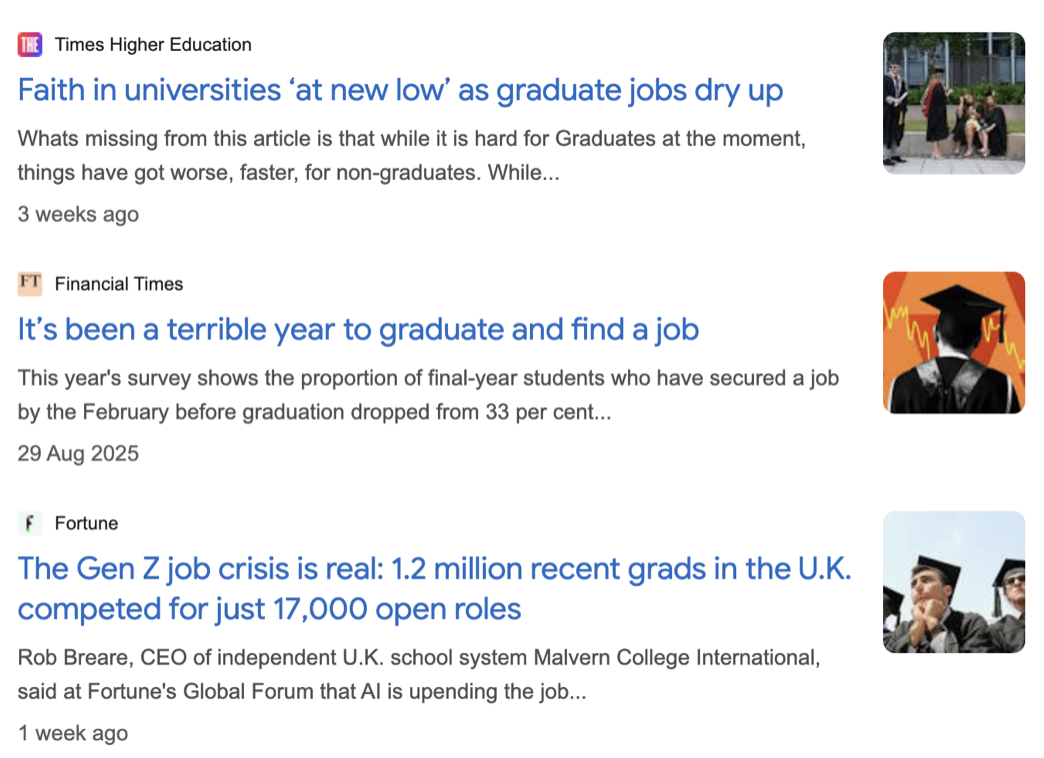
As AI usage transforms every business in the economy, there is a growing mismatch between graduates, and the job market.
Companies are not hiring as many entry level roles, and more and more generically educated graduates are competing for a limited number of roles.
There are two core problems as we enter the AI age – the education system and our economic system need to be updated.
In this article I will focus on how I think the education system should be updated for how students can prepare for an ever changing digital world.
The taxi driver problem
For some reason I’ve had many conversations with taxi drivers about their careers and business models. They all have quite different setups.
One of them recently asked me how to find better opportunities.
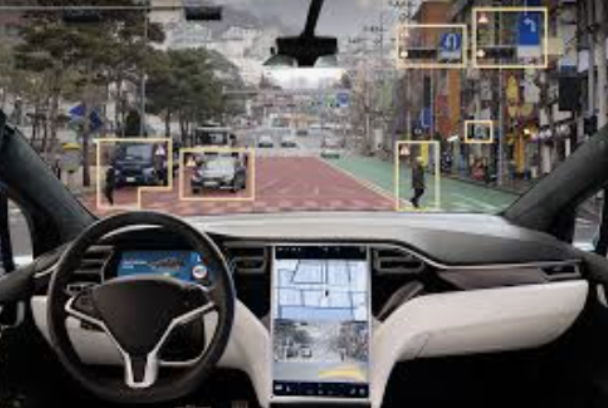
With millions of taxi (and truck) drivers around the world, and self-driving coming in. One thing is for sure, that millions of people are going to have their livelihoods displaced. What is the solution to that?
Up-skilling and retraining is going to be essential for taxi drivers but also many other professions from customer service, recruitment, design, administration and management and more.
We are facing the biggest societal disruption since the industrial revolution
I grew up in Bedfordshire which is one of the places that drew inspiration for the Shire in the lord of the rings. A place of safety and a refuge from the conflicts.
As I come back to the shire from living in China and Dubai I have the sense that people don’t realise how much the world is changing.
The rest of the world works 7 days a week, and builds their industrial and technological capacity.
The laws of nature still apply, and the idea that we can continually sustain these luxuries is something that needs real work. We need to become a little bit more hardcore.
Who am I?
I am founder of an online study abroad platform called Global Admissions. I have lived in China, UAE and UK. I have learnt these lessons from 18+ years of working, reading, and experimenting. I don’t think it’s necessary to learn from experience and it’s possible to learn it all in day one. Here is my attempt to put what I’ve learnt so you can learn it in 30 minutes, and have come to think is the best path for career development.
Dogma
What should you do in this time? I see a lot of different ideas being presented as truths.
“Study hard, go to university, working hard, get a job”. I don’t think this is enough anymore.
Many people are saying that you need to build a personal brand and create content. Others are saying you need to learn AI to succeed.
Will all jobs be taken by AI in the future?
The ideas on social media and in media are often quite one sided and polarising. The truth is usually much more nuanced.
My answer: it depends on you. Here is my attempt to build a road map for you to navigate the changing labour market.
The Economy Has Changed
These are the main shifts in our society that we’ve had.
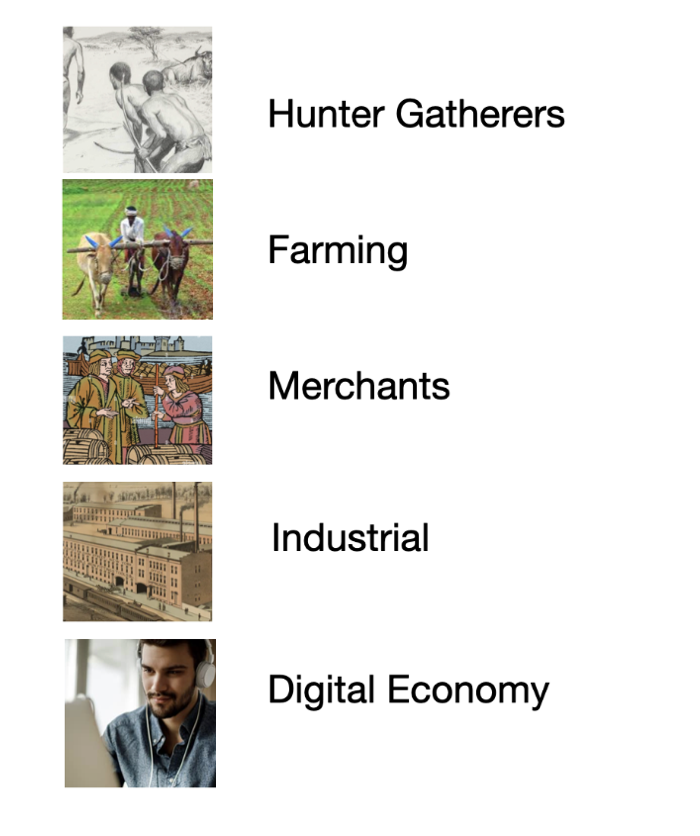
Hunter gatherers were more egalitarian. In farming, control of the land become the key asset with wealth being concentrated into the landowners. As we entered through each stage, everything changes.
The mercantilist era and industrial revolution saw one of the biggest population increases as wealth become allocated to a growing middle class and we saw improved healthcare and longevity.
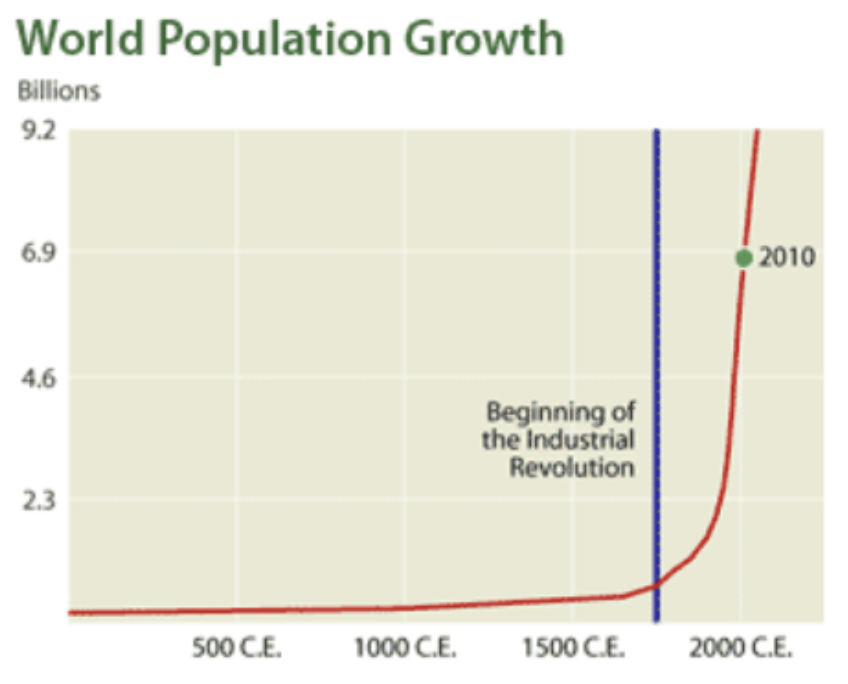
We are now in the early stages of a transition to the digital economy. While our digital infrastructure is transitioning, we are yet to see how this will play out in the labour market and education system.
Digital Economy Means Winner Takes All
The book of many of the principles for organising society in the industrial age was “The Wealth of Nations” by Adam Smith.
We would see the division of labour and economies of scale and the famous pin factory. Multiple people working together focusing on specific parts could produce far more pins than individuals doing the entire process.
One of the key aspects of the industrial age was that it was far harder to measure the best from the worst, and so everyone was paid quite proportionally for their time.
In the physical world, we typically see a bell curve distribution of abilities – such as height or IQ, and so we saw the massive growth of the middle class.
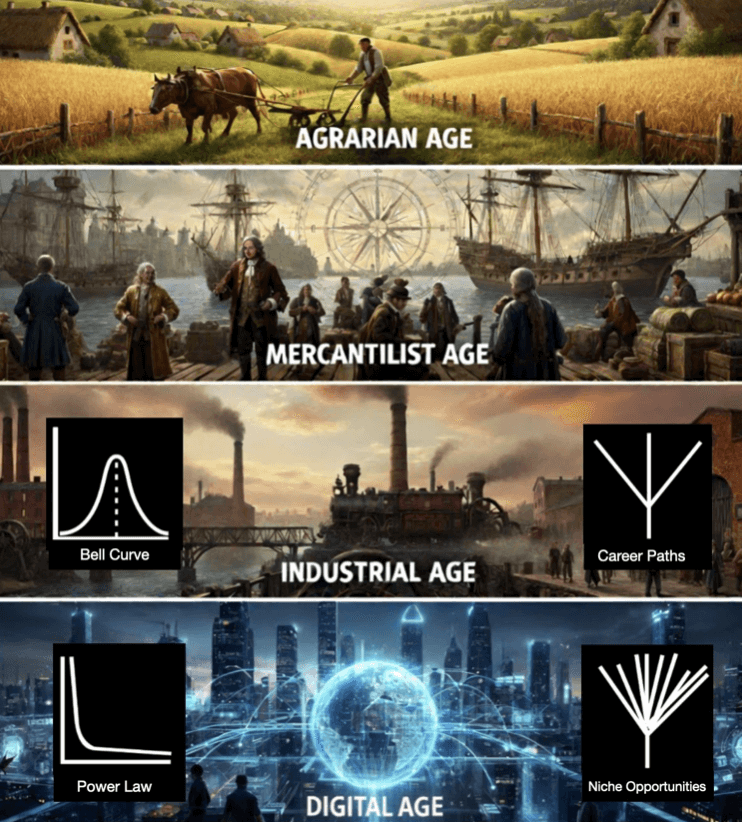
In the digital age, we no longer have the friction of the physical world. Results are therefore allocated according to a power law, with the best performers receiving the majority of the benefits.
This fundamental shift is transforming the labour market and wealth distribution.
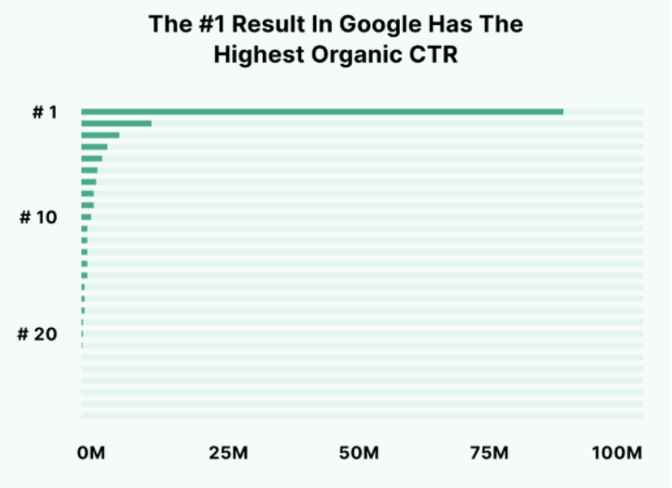
One example of this is how the number 1 result on google receives the majority of the benefits. In the digital world, everyone watches the top creators. The average is now almost invisible. The bar of competency needed to compete is now much higher, but the benefits much greater.
Digital Economy Means Infinite Choice
The other aspect is that in the industrial economy, there were limited choices. In the job market, there were only a few career paths you could choose. Now there are an almost infinite number of choices in different niches.
The End of Jobs?
In the agricultural era, and for most of human history, we operated on the principle of unfree labour.
The industrial era saw the rise of the job.
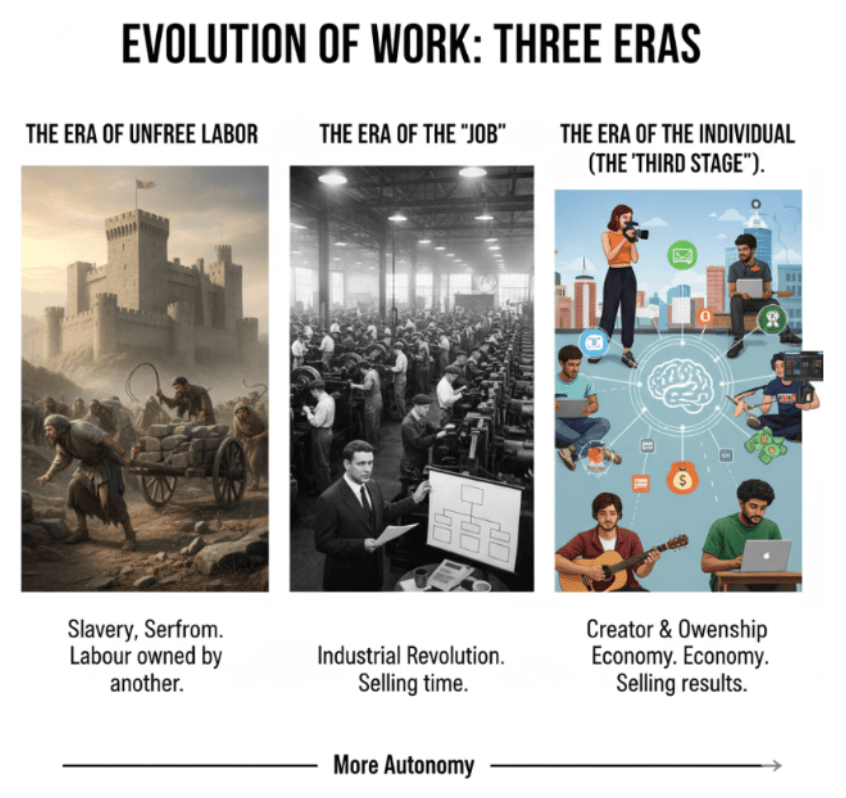
The shift was driven by moral and economic arguments, but it was largely driven by an economic reasons. Adam Smith explained how wage labor was inherently more efficient because a worker who benefits directly from their effort is more motivated and productive than a coerced laborer.
I am sharing this not to highlight the morality of this shift, but that in the modern era, when all of a persons wage goes on living expenses, is there much difference between the first two stages?
We are now entering a new era for many where a growing number of people can be creators, or owners. Instead of selling their time, they are selling results. In each stage, they are seeing more and more autonomy.
Don’t look for jobs. Look for opportunities.
As we enter the third stage, we should no longer seek jobs (to find a master), but seek opportunities and problems to solve, and then present solutions. This different mindset is the mindset of the digital economy. We embrace autonomy, ownership, creation and products. It requires a deep understanding of the economy and the marketplace that was not necessary in the first phase, and less needed in the second.
There are an infinite number of problems to solve.
The Structure of the Economy Has Changed
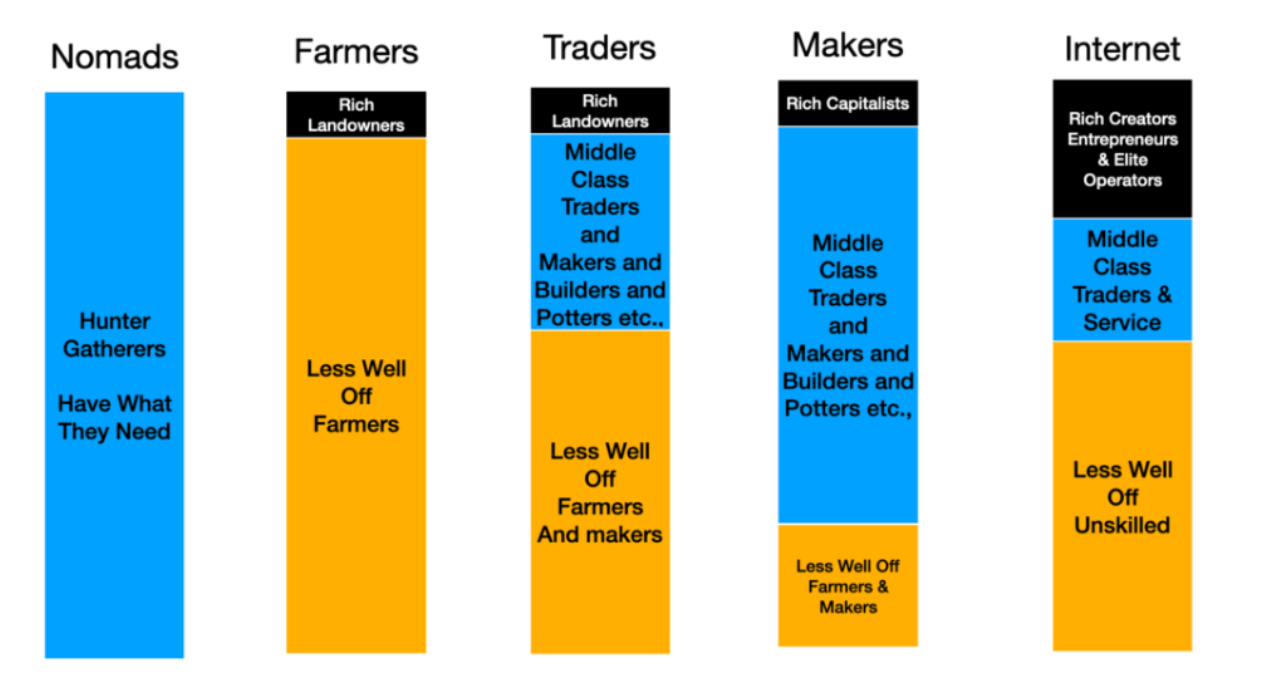
The middle class saw the rising middle class, but the digital economy is seeing the splitting of the middle class. This is what the distribution is likely to look like if nothing changes.
We are seeing the shrinking of the middle class, each year, by rising living costs. I highlight this to demonstrate the urgency and requirement for you to upgrade and that you can’t afford to be the same and follow conventional wisdom, because conventional wisdom exists for a different age.
And because if we operate on the principles of the industrial economy in the digital economy, the system will fail.
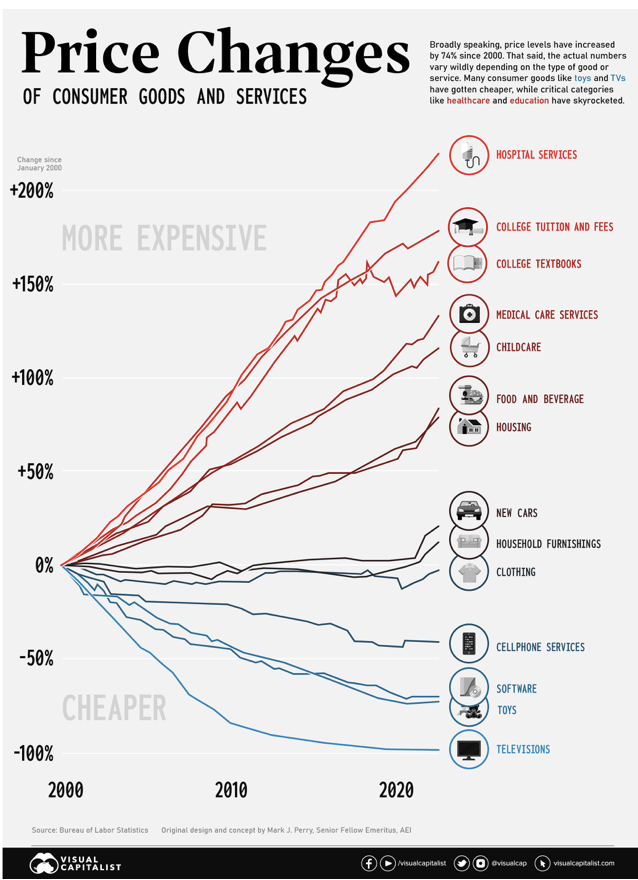
In order to prevent this as we enter the digital age, we are going to need to implement universal basic income, or reduce living costs. I would argue that it’s essential to make healthcare, housing, and education subsidised or free in the digital age, because these are infrastructure that are needed for a society to operate.
Infrastructure is the basic physical and organizational structures and facilities (e.g. buildings, roads, power
supplies) needed for the operation of a society or enterprise.
I predict we will have a different economic system, and will discuss that later. For now, while our economic thought catches up, here is what you can do as individuals in the meantime.
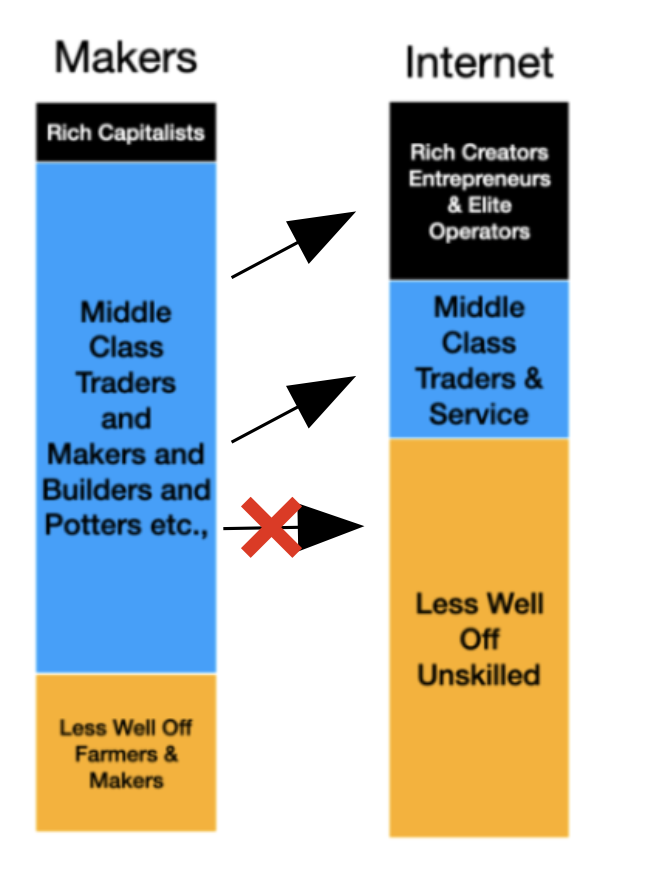
It is absolutely necessary to up skill and learn new skills to move to the higher level of the economy. As a society, we need to invest and carry out massive retraining.
But what should you learn? If everything is always changing. Here is a framework that I’ve come to understand.
There are two types of directions. The first is about leverage, the second is about what it means to be human. I will first explore the leverage types.
Four Types of Leverage
In the digital age, these types of leverage replace the factors of production. We are now longer in a production economy, we are in an attention economy where attention is the most scarce resource.
There are four types of leverage
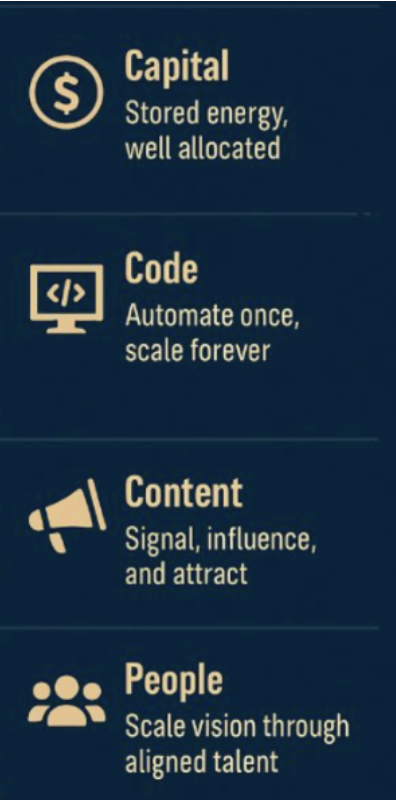
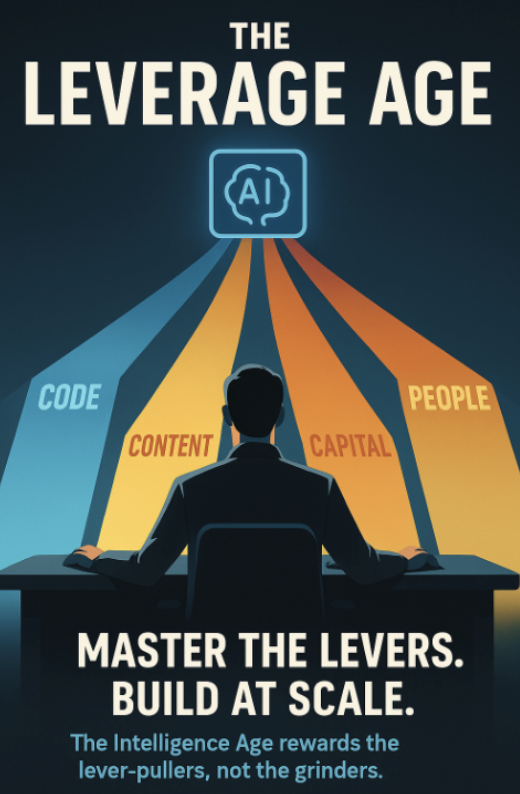
Capital and people are what Adam Smith mentioned as core factors of production. Content and code are the new types of leverage that exist in the digital economy and are transforming the economy.
With one video it is possible to reach millions of people.
With one piece of code it is possible to perform the work of millions of people.
These are where some of the biggest opportunities in the economy are right now. In order to succeed in the digital age, it is essential to understand all the types of leverage, and to build an advantage in one of those that best suits you. Everyone has a natural advantage in one type, and those that they are weak at.
It is also possible to build a leverage stack of multiple types of leverage working together. Social media platforms are one such examples, where they deploy capital, use code to connect people, and build teams, and coordinate creators.
Alex Hormozi is someone who embodies all the principles of leverage. Creating content, investing in companies, hiring talented people.
There are still highly paid jobs that exist as we enter the digital age. Lawyers can be one example. But anyone can benefit from leverage. Lawyers could create content such as a podcast, book, or social media, or use AI to support their work, hire people, or use capital in financing.
How leverage changes things?
It now matters more what you work on, and being the best than how hard you work. It feels weird and counterintuitive
The Leverage Gap
If you are not using leverage in a leveraged world, you are being outcompeted – and under living your potential. The leverage gap is the difference between your current results and those that you can get with leverage.
An example can be someone who sells baskets on the street compared another person creating content about baskets online and an online shop, investing capital and building a team.
The Leverage Flywheel
You can also build a flywheel of leverage
Internal Skills of Leverage
We also have internal skills of leverage. Learning becomes the master leverage which enables you to bootload all the others.
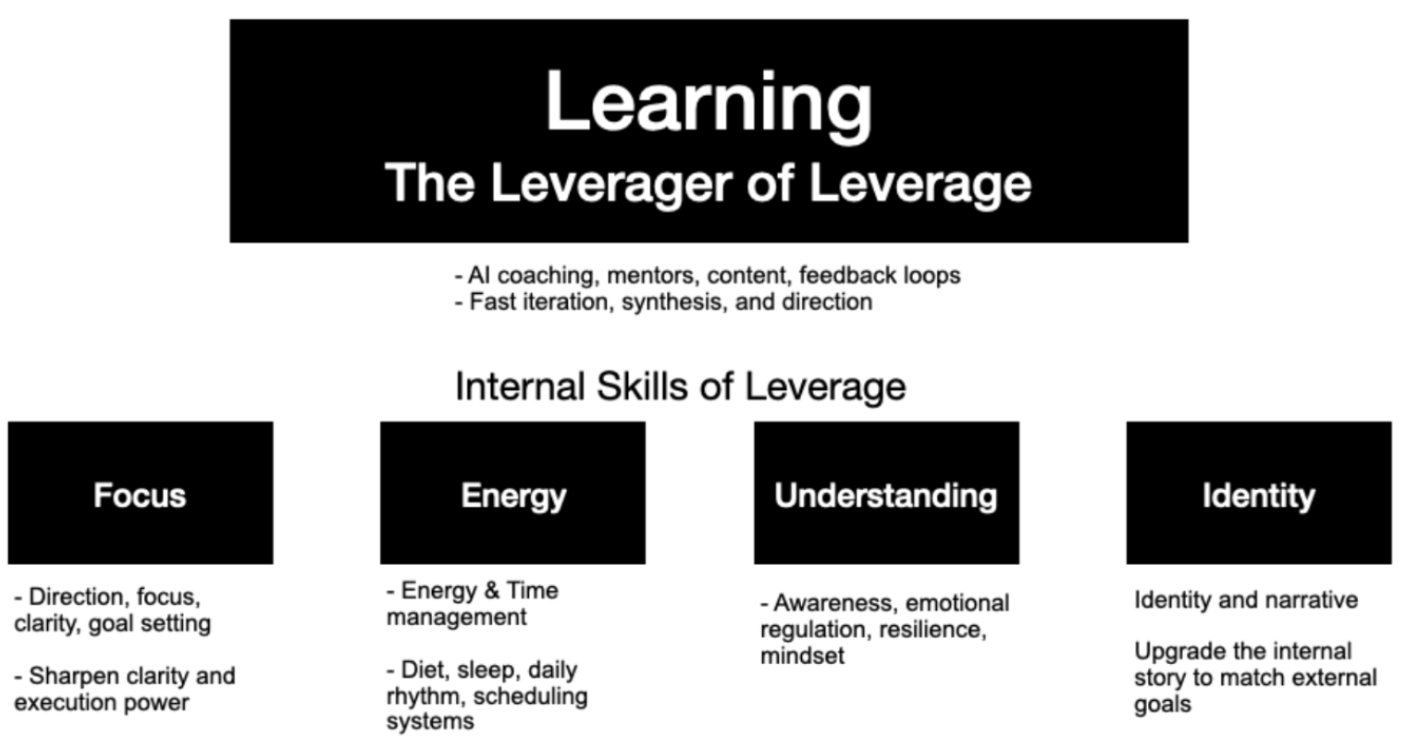
The other aspects of leverage enable you to direct the tools of leverage better. Because we now have better, more powerful tools, the ability to direct them becomes more important.
Whats important with the tools of leverage?
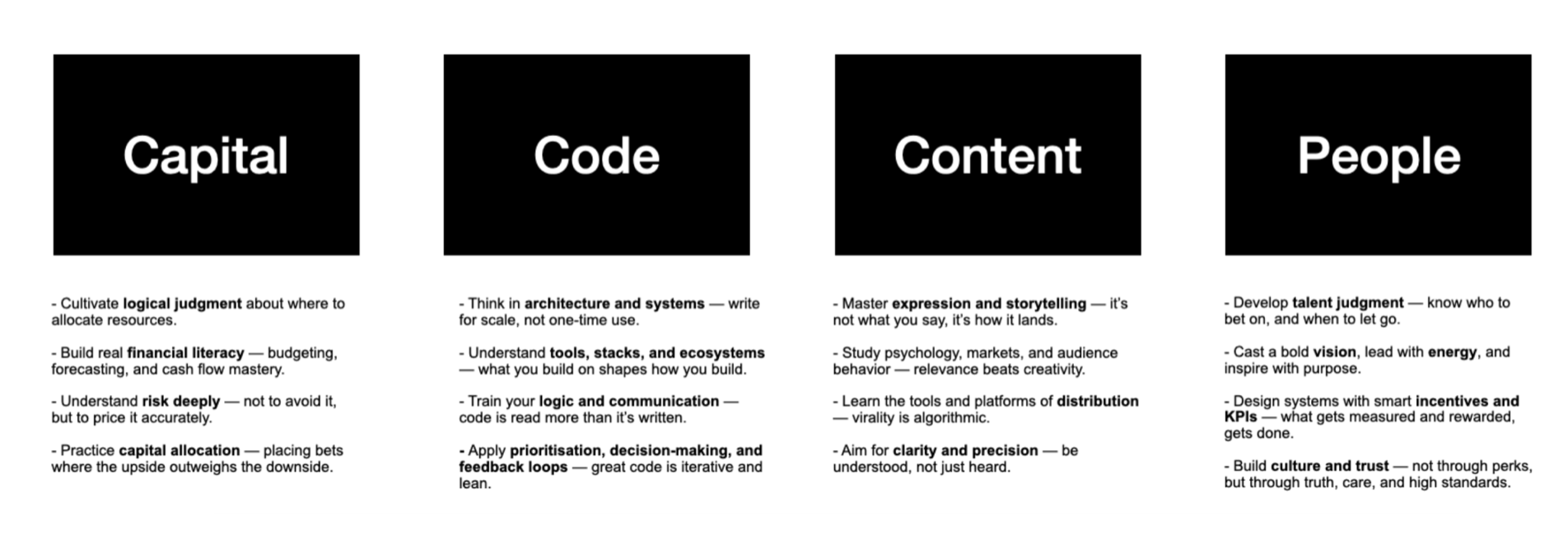
Each tool of leverage needs different skills. I have a quiz you can take at the end.
Low Leverage Loop Trap
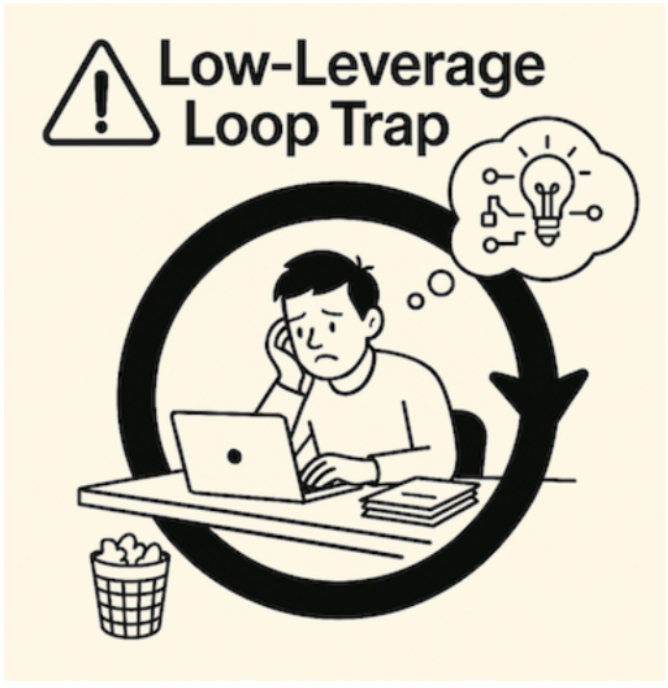
Many people who are working are limited because they are working on low leverage things. I know this from my own experience. In the digital economy, if you are not seeing an exponential increase in your results and your income, you are limited because you are not applying leverage. It’s essential to break out of the low leverage loop trap by finding the bottleneck and then applying leverage.
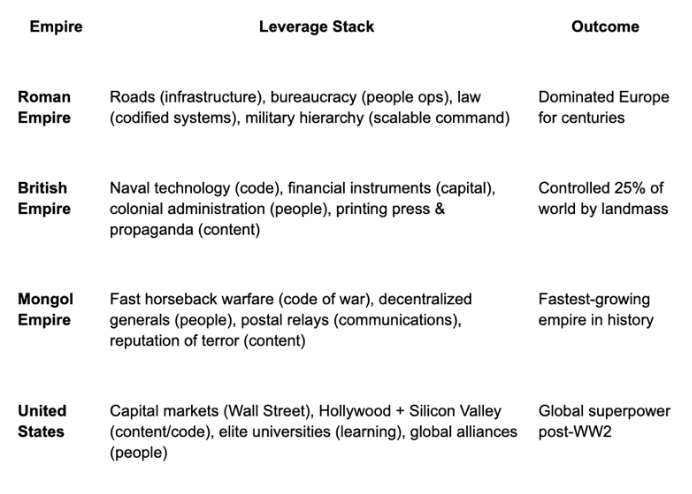
Empires of Leverage
You can also look at empires in history of using leverage. Content, culture, code, and finance, and organising people better than other empires is what gave them competitive advantages and allowed them to conquer others. Being able to apply empires is essential for strength and defense.
Duality
With every trend there is also a counter trend. Leverage comes first, the human side comes after that, and it is just as essential.
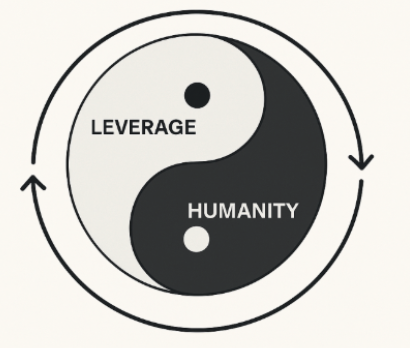
Every age has its duality – capital and labour, reason and emotion. The duality of this age is leverage and humanity.
As Leverage Becomes More Important so Does the Human Side
What does the human side look like?
– Care
– Empathy
– Judgement
– Taste
– Alignment – Vision, Direction
These become more important as we have new powers of leverage in the digital age because they are super-skills that technology can’t replicate.
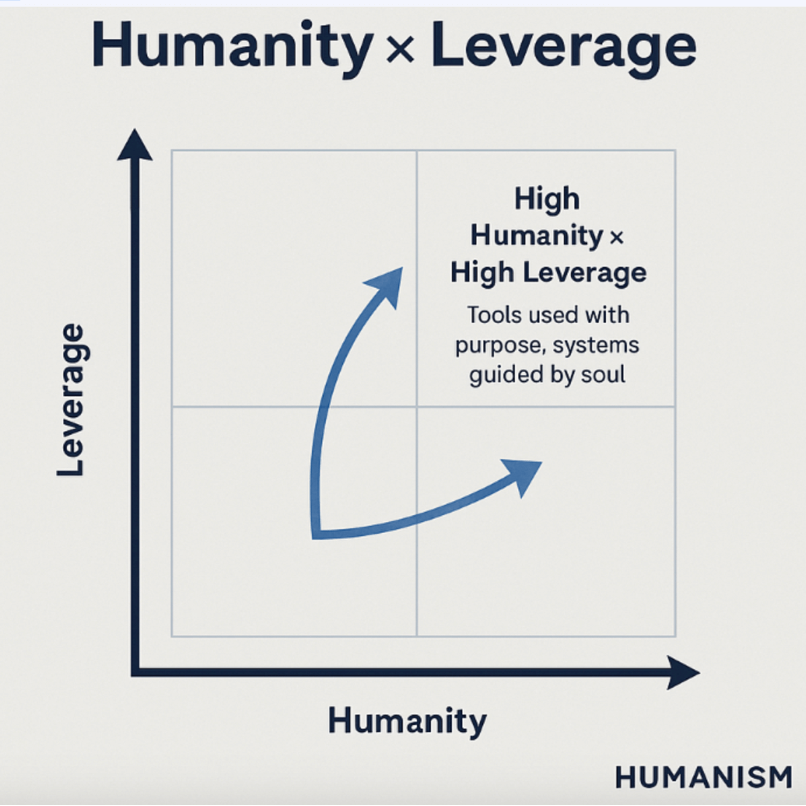
We can put every job into one quadrant based on how much leverage and how much humanity is needed.
Low Humanity, Low Leverage
– Data entry, cashiers, drivers. As leverage increases, many low-humanity, low-leverage tasks get absorbed by AI, code, or systems. The person can be guided into roles of greater humanity, creativity, and connection.
❤️ High Humanity, Low Leverage
– Therapists, Nurses, Teachers. Sacred roles, but can still benefit from understanding or using leverage because we are in a leverage economy, and to maximise impact.
⚙️ Low Humanity, High Leverage
High Frequency Trading Bots, Instagram Feeds, Onlyfans, Private Equity Strip & Flip, Multi-Level Marketing Schemes, Clickbait Personalities / Outrage News. Without grounding in human values, this quadrant can easily become extractive – driving inequality, addiction, and harm.
🌟 High Humanity, High Leverage
Teachers or Therapists using content or designing systems to reach people at scale, Regenerative Finance, Community Leaders. Many new roles and opportunities we can’t yet imagine
The bottom left quadrant is removed as we can use machines to perform. So we can move into the high human side or high leverage or both which is the top right.
There are essential roles such as nursing, electricians and plumbing that require humans are in short supply now.
What The Curriculum Is
The essential sklls in the digital age are therefore to understand and become capable at leverage and the human side.
- Leverage
– Code
– Content
– Capital
– People - Humanity
– Empathy
– Judgement
– Understanding
– Taste
– Aligment
Solving the Taxi Driver Problem
Taxi drivers and those in the bottom left quadrant can upskill into another market or they can use their human skills or leverage skills or both.
The advantage taxi drivers have now is that they have huge amounts of time that they can listen to educational content to upskill and prepare for this.
Bespoke local guides, personalised care for disabled or those needing safety are some areas that will be required although much smaller. Or changing to roles that require people and more human skills such as electricians, plumbing or care.
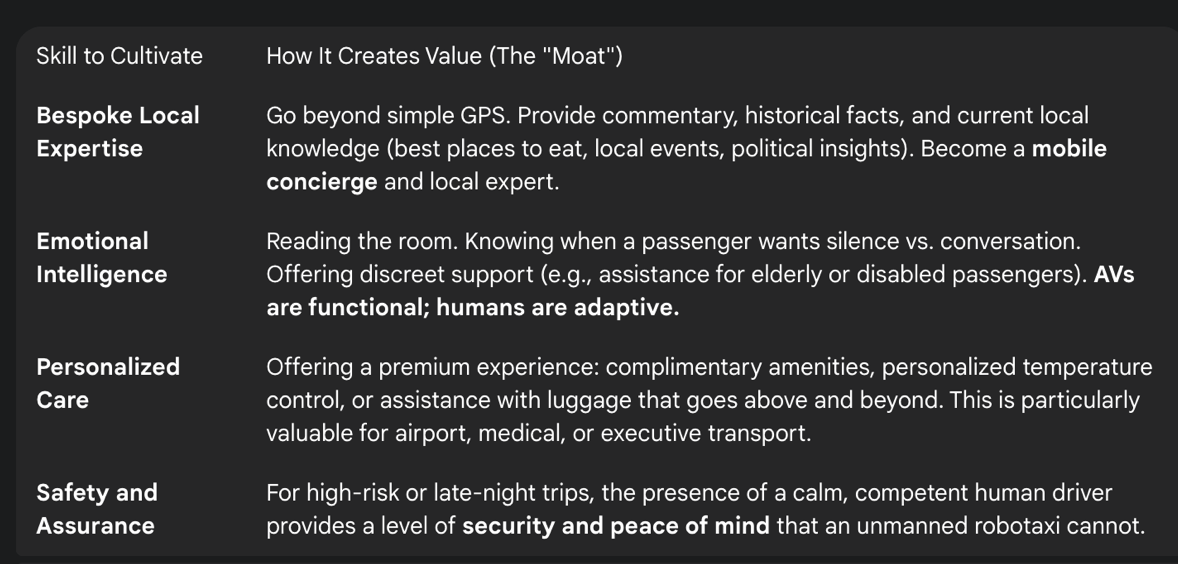
Creating content in a specific niche they are interested in, or up-skilling is also an option. With so many taxis could they be turned into teachers, so you can book a taxi driver and have a lesson, or counselling session at the same time? or consulting or meeting. They could also move to community roles.
I don’t have all the answers, but a framework for how this problem can be navigated.
8 Ways to Prepare for the AI Economy
Here are 8 ways to prepare for the AI economy.
1) 📚 Learning needs to be continuous
If you can learn you can do anything. It’s the core skill that’s needed in today’s economy.
There are lots of free courses online
Coursera / edx
YouTube / books
Mentorcruise
But, there are almost too many resources, what should you learn?
2) 📈 Demand Supply Discrepancy
Where is the demand far outweighing supply?
This sounds obvious but it took me ages to really really learn this. I thought it just matters how well you work and your results, but I saw others doing a fraction of the work and earning far more. It’s all a market. It’s essential to fill a missing need.
Opening another pizza restaurant next to 3 others just isn’t going to be profitable however hard you work. In a market your effort doesn’t matter if you’re selling the same product as others and it’s a commodity. Apple can charge much more because it’s totally unique. It’s essential to find where there’s a big need, or problem that’s unsolved and go there.
In UK there are 728k jobs listed on LinkedIn and massive gaps in
– cybersecurity / ai
– e-commerce
– plumbing / electrical / ev installs
These could be short term or have opportunities.
3) 🔍 Hyper Specialise
A great career strategy is to focus on some hyper hyper specific thing (for me – starting at recruitment of law schools in china) become great at that, then expand, become great, repeat to bigger market when it’s saturated. Even better is to pair leverage + your subject / interest
Eg.,
– AI optimization for museums
– social media marketing for personal injury law firms
4) 📹🤖💸Use Leverage
We’re now in a leverage economy – content, code, capital, people. It you can master these tools – you can put in a little effort, and see huge results.
At the same time, the power of these tools, makes your effort relatively less valuable. Judgement, understanding, taste becomes more valuable. In a leverage economy. If you don’t understand leverage, you’re at a disadvantage to those who do. It’s counterintuitive because working harder feels like the right thing to do. But one YouTube video can reach thousands, continually. Code can work forever for free, you can build it or no-code it.
There is a dogma that you need do build a personal brand to be successful but that’s just one form of leverage.
Combine the missing need and your niche with whichever type of leverage your best at.
Are you great at writing or videos or speaking? Create media. Content and code are the easiest because they’re newer. In the leverage economy essential to understand all forms of leverage, but only need to specialise in one or two.
Combine capital + code (crypto) + people + content (build a team creating content about it).
5) 🧠 Mindset
Emotional awareness, energy, diet, sleep are all things that can give huge advantages (internal leverage).
How you look at the world reflects what you see back.
6) 🛫 Be Location Independent
If you move to another location you’ll understand two markets, learn more, get unique insights, can work between them, or choose the best for you.
7) 👩🏻💻The Internet is the Frontier
The internet is the new constantly expanding frontier and new opportunities are found at the frontier.
8) ✅ Build Proof of Work
Get started on projects to get results, make YouTube videos or podcast about topic of your focus, it matters more than resume.
9) ❤️ Develop your Human Side
Human side matters more. Alignment wins market share. Understanding people is an advantage. Judgement creates better products, content and allocation. Leverage is controlled by humans, for humans
It also makes you happier and a better human
Dogma Vs Reality
What you work on matters more than just “working hard on anything”
Content and AI are one of the big opportunities now but what you work on depends on your skills and personality.
The nature of jobs is changing and they are now opportunities.
It’s essential to think more entrepreneurially and understand the market.
Our Human side is now more important, not less.
Summary
We have moved from the Industrial Age into a “Digital Age” or “Leverage Age”, which operates on different rules.
The Problem: AI is automating the economy , and the old advice to “work hard, get a job” no longer guarantees success. The Digital Economy is a “Winner Takes All” market , but it also creates “unlimited
opportunities in different niches”.
The Solution: Leverage: The key to success is using “leverage.” Code, Capital, Content and People.
The Duality: Leverage + Humanity: As leverage (tools, AI, systems) becomes more powerful,
“human” skills become more valuable. These include empathy , judgment , taste , and alignment.
The Goal: The ideal path is to operate in the “High Humanity x High Leverage” quadrant
using powerful tools and systems with purpose and “soul”. Roles with low leverage and low
humanity (like data entry or drivers) are most at risk of being automated.
Learning and upskilling is essential. Engage in continuous learning, find a specialized niche , master at least one form of leverage, and simultaneously develop your “human side”.
