It’s a perfect storm now for universities worldwide. Birth rates are falling, key markets are shrinking, and we have an AI Tsunami, and in many countries people are questioning the value of a degree and how to fund higher education.
There is increasing competition for the top talent by universities and countries all over the world. Students are now engaging with and applying to an increasing number of institutions and have many more opportunities than ever before. At the same time students have higher and higher expectations. The bar is continually raising.
Every student is researching online now, but one of the challenges university marketing teams have is the attribution gap. Students are researching for 6-18 months and using multiple platforms and resources. How do we know which activities are working and lead to results?
While eliminating the attribution gap entirely is unrealistic given the student journey, we can improve visibility by working with agents and improving tracking and analytics. But we need to rethink the student journey and what it means to be a brand.
How Agents Solve it
Study abroad agents are a multi-billion dollar industry and represent an “easy solution” for marketing and the attribution problem in international recruitment. They offer perfect attribution. Universities know precisely which students came from which agent, allowing for clear, direct commission-based allocation of marketing budget. However, their value and role is shrinking and misses out on the future opportunities.
Study abroad agents is a multi-billion dollar industry because they solve this problem. But while agents often work incredibly hard, but their core value is can be best understood as cultural and linguistic translators. Their primary value is bridging the trust gap between students/parents in non-English-speaking countries (e.g., China, India, Vietnam) and foreign institutions. This is why the agent ecosystem is dominant in countries with significant cultural or language barriers to the destination country, but minimal in native English-speaking markets like the UK, US, or Western Europe.
The agent model is weakening due to falling birth rates, the need to keep changing agents and markets and having key market risk, and the rise of the internet, AI, and social media as an alternative.
The internet AI tools, platforms social media (like large language models and advanced search) now provides personalized, multilingual, 24/7 answers on courses, deadlines, and requirements – reducing the need for a human intermediary for the initial research and discovery phases.
The agent model inherently misses out on the segment of top-tier, self-directed students in any country, as well as the entire demographic of native English-speaking markets who research and apply independently.
Agents are essential in specific high-volume, high-barrier markets today, but relying too much on them is not a sustainable long term strategy. The future demands that universities solve the underlying attribution problem by building direct digital relationships, turning agents into a supplement rather than a dependency.
Effective Digital Marketing
The most effective strategy is to rethink marketing as building brand gravity, and a digital ecosystem. To extend reach by building digital assets, eg., webinars, videos, material, resources, short online courses or short term in-person programs that bridge the gap, meeting the students where they are and converting them between interested students and enrollments. This helps to attract students however they engage, driving your institution’s long term success.
Defining Your Institutions Specific Focus
It’s increasingly essential to have a clear focus and to bring out the advantages of your institution and programs. To be the best at something and / or to be the best option for a specific someone, and align all communications and marketing with that. The types of focus are:
– By degree or subject.
– By teaching method.
– By values or mission
– By location or industry – becoming an anchor institution.
Or some combination of the above.
This makes marketing, and conversions much more effective.
Building Brand Gravity
Brand helps to communicate values and differences and acts as gravity that attracts students. In the digital world it is no longer a sales process but more like attracting them and keeping prospective students in orbit by developing a strong and flourishing brand. Brand gravity is about optimising every touch point the student has with the institution. To be most effective, it is not a purely marketing function but fully integrated with the institution activities and community. One of the advantages of the strong brand is that it attracts the right fit students, increases student conversions throughout the recruitment funnel, and even improves their satisfaction and success when enrolled as the strong brand forms a part of belonging and identity.
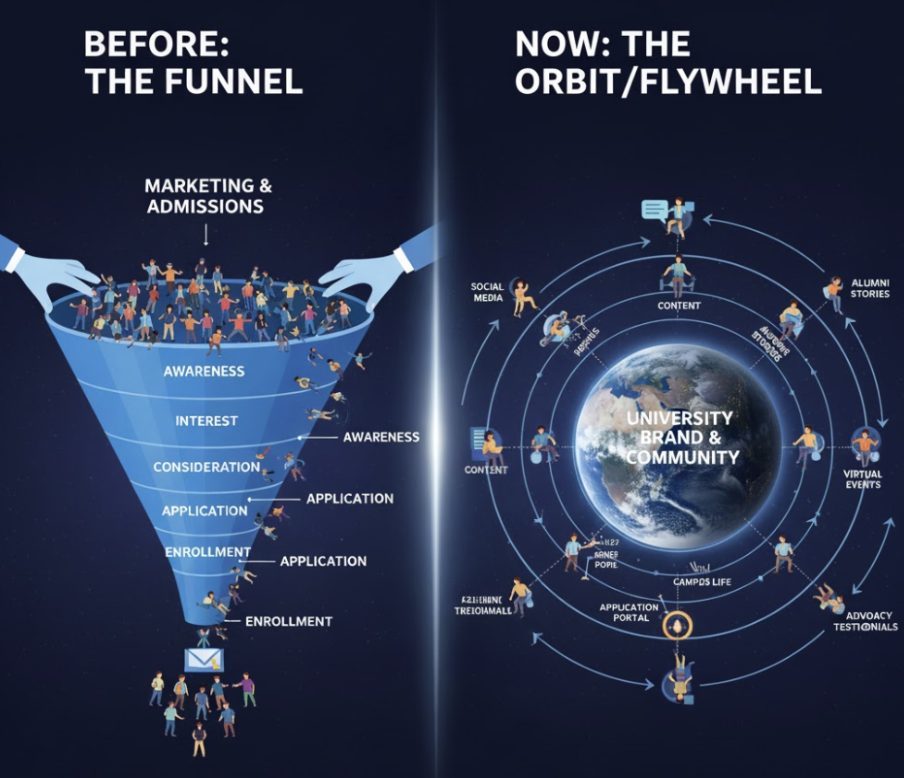
The funnel is now more like the landing sequence as they come down to land from orbit.
Creating Digital Assets that Attract and Drive Conversion
Building Digital Assets – videos, guidebooks, reports, webinars and masterclasses are some of the most effective ways to attract students, and help them stay in orbit or move down the funnel to take action when they are ready. Content creation and building the ecosystem helps to bridge the gap and also to support AI and social discoverability.
People are the Brand
Students connect more with people than brands. It’s extremely effective to elevate the people of the community – star professors, successful students. This also helps them become more successful which acts as a virtuous loop.
